
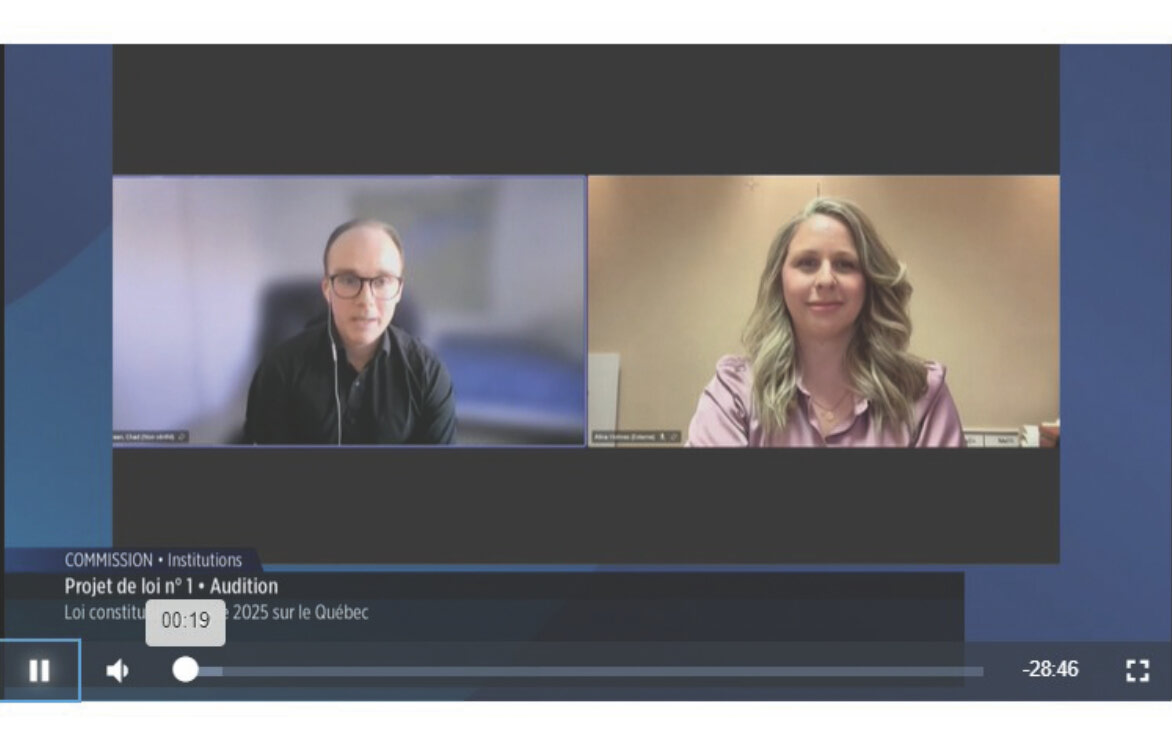
Chad Bean and Alina Seguin-Holmes of the Regional Association of West Quebecers presented to the National Assembly on February 5, urging lawmakers to amend Bill 1 to better protect individual rights, minority communities, and essential public services. Photo: Screenshot of the National Assembly of Quebec, Commission on Institutions hearing on Bill 1, February 5, 2026.
Regional association challenges gaps in Quebec Constitution Bill
Tashi Farmilo
The Regional Association of West Quebecers presented to the National Assembly’s Commission on Institutions on February 5, voicing strong concerns about Bill 1, the proposed Quebec Constitution Act. Speaking for more than 60,000 English-speaking residents in the Outaouais, association president Chad Bean and executive director Alina Seguin-Holmes focused their remarks on what they see as serious gaps in the bill’s protections for individual rights, government accountability, and access to essential services.
“We were pleased to have been one of the organizations asked to present in front of the committee,” Seguin-Holmes said. “We believe that the process by which Bill 1 was developed was flawed and lacked public consultation before it was tabled.” The association used its allotted time not to oppose the bill outright, but to push for changes aimed at strengthening inclusivity and democratic safeguards.
At the hearing, Bean and Seguin-Holmes called for the inclusion of clear, enforceable guarantees for healthcare, education, affordable housing, linguistic protections, and public safety. They warned that the bill’s current structure risks prioritizing the collective rights of the “Quebec nation” over the rights of individual citizens, particularly members of minority and anglophone communities. “We chose to use our presentation time to focus on areas of the Bill that we believe should be modified to improve inclusivity for all Quebecers and accountability for the government,” Seguin-Holmes told the commission.
Particular concern was raised over Section 17 of the bill, which gives the provincial government the power to direct institutions such as school boards and hospitals to refuse federal funding or withdraw from federal agreements. Bean warned this could jeopardize access to essential services across Quebec. “This section empowers the minister to order organizations like school boards, universities, and hospitals to refuse federal money or suspend agreements, potentially disrupting critical sectors without broad consultation,” he said.
During the exchange, commission members asked whether the group believed the bill’s emphasis on secularism and French language protections could be considered discriminatory. Seguin-Holmes responded that the problem lies not in the wording of these provisions, but in the lack of constitutional safeguards to prevent future governments from implementing measures that could discriminate under the cover of collective rights. “It’s written in a way that leaves room for discriminatory practices to be put in place,” she said, emphasizing the need to embed protections for individual freedoms directly into the body of the bill, not just the preamble.
The association also recommended changes to the bill’s amendment process to ensure greater public participation and accountability. While Bean and Seguin-Holmes expressed a preference for restarting the legislative process with proper consultation, they said that, given the current political context, the focus should now be on improving the bill before it becomes law.
“We support the idea of a Quebec constitution that prioritizes the well-being of its people,” Seguin-Holmes said during the presentation. “To achieve this, we encourage guarantees for social essentials, protection of individual rights, maintenance of judicial oversight, and preservation of federal collaborations and democratic amendment processes.”
Bill 1 was introduced in October 2025 by the Coalition Avenir Quebec government. It remains under committee review. Framed by the government as a necessary step toward affirming Quebec’s distinct status and constitutional autonomy, the bill has sparked sustained opposition from legal experts, minority organizations, and civil rights advocates, who argue it concentrates power and leaves minority groups more vulnerable.
“We urged the committee to carefully consider each recommendation to ensure the final bill is reflective of the needs of all Quebecers,” Seguin-Holmes said. “This is an important issue for residents of the Outaouais.”