
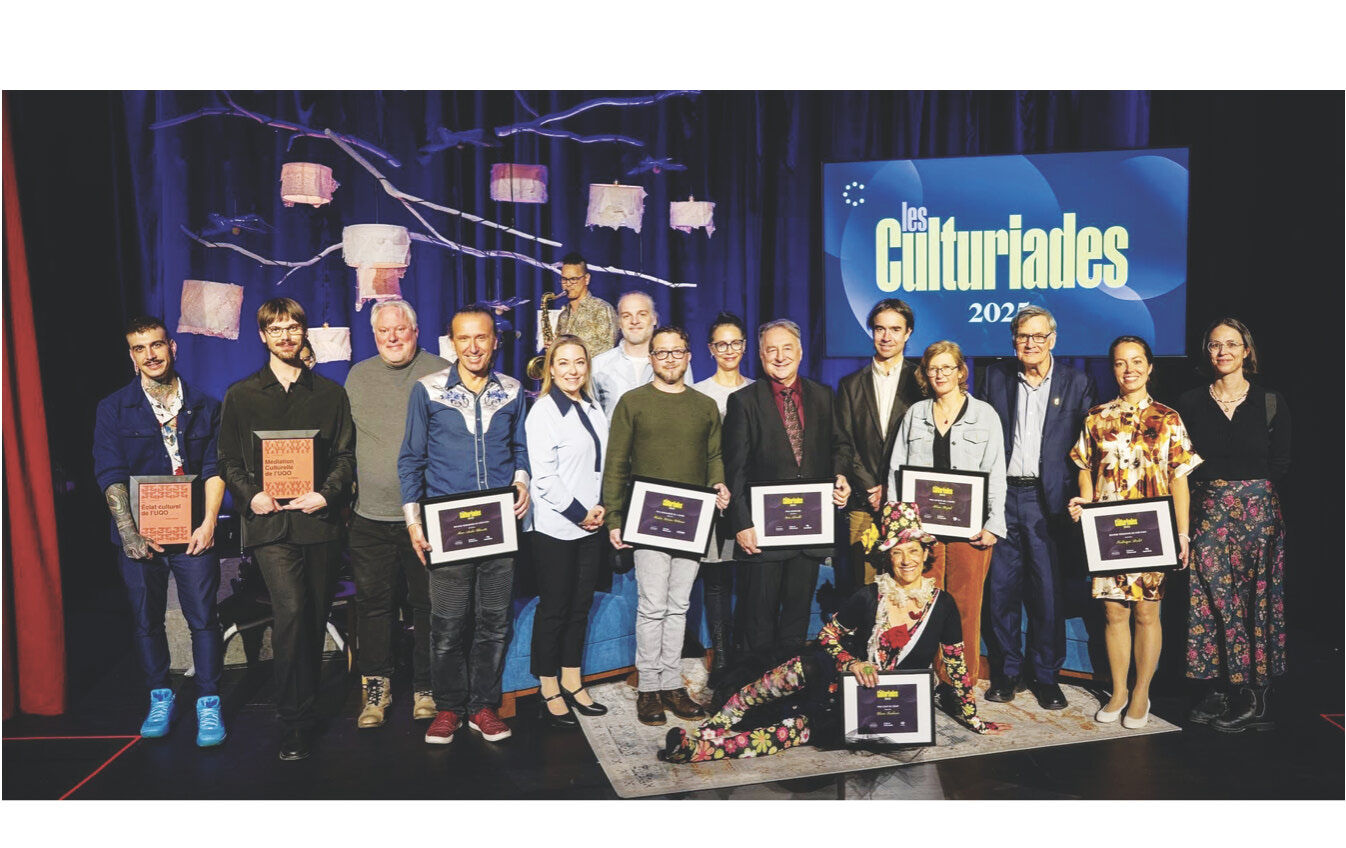
Culture Outaouais is renewing its call for the creation of a Gatineau Arts Council to provide more structured support for professional artists, a proposal that aligns with recent cultural milestones such as the awards ceremony at the Culturiades last November in Gatineau. Photo: Marie-Andrée Blais
Momentum builds for a Gatineau Arts Council amid growing cultural needs
Tashi Farmilo
The longstanding proposal to create a Gatineau Arts Council is gaining renewed momentum, as cultural leaders and municipal officials alike confront the challenge of how to support and retain professional artists in the region. Advocates say a dedicated council could provide the structure and stability that have long been missing from Gatineau’s cultural framework, and the City itself has launched a formal analysis into the idea’s feasibility.
Clara Lagacé, co-president of Culture Outaouais, said the proposal has been on the table for years. “This isn’t a new idea,” she said. “We’ve been calling for it to better structure support for professional artists. Right now, there’s no meaningful municipal-level funding for professional artists, and that’s a major gap for a city of this size.”
Recent years have seen important steps forward. Gatineau has already modernized its Programme de soutien aux organismes culturels (PSOC), integrating internationally recognized arts council practices such as peer and expert jury evaluations, mission-based funding, and multi-year agreements aimed at offering greater stability to organizations. In 2026, the PSOC budget will rise from $1.2 million to $1.5 million, with a gradual increase to $1.85 million projected by 2028. Culture Outaouais welcomed the increase but noted in a December press release that the program still only covers about 32 percent of the sector’s funding requests.
Lagacé described the current level of direct municipal support for individual artists as minimal. “There’s only one artist residency per year. That’s it,” she said. “It’s not enough to build or retain a vibrant cultural community. We need a structure, a clear, independent body that can distribute funds and support in a fair and transparent way.”
The City is now conducting a full-scale analysis of the council proposal. A first phase of consultation was held with cultural organizations in summer 2025, and a second phase focused on individual artists is planned for 2026. Officials say the consultations aim to build a deep understanding of the needs, roles, and realities of the city’s cultural actors, and to develop a governance model that aligns with Gatineau’s unique context.
In parallel, Culture Outaouais has been mandated to produce a comprehensive portrait of private arts funding and philanthropy in Gatineau. The findings will help determine how public and private financing can work in tandem, ensuring complementarity rather than duplication. Lagacé acknowledged the importance of private support but stressed that it cannot replace the need for strong public infrastructure. “Philanthropy is complementary,” she said. “But the foundation needs to be public. And that foundation doesn’t exist yet in Gatineau.”
While the City’s timeline points toward the possibility of integrating a council into the 2028 to 2030 cultural policy action plan, Lagacé expressed concern about the delay. “We understand that these things take time,” she said, “but artists are making decisions now about whether they can stay in Gatineau or have to leave. We can’t afford to wait too long.”
She clarified that Culture Outaouais is not seeking to assume the role of a future council. “We’re not advocating for more power or money for ourselves,” she said. “We’re advocating for a structure that works, one that exists in other cities and provinces and is proven to serve artists well.” The goal, she said, is to create a one-stop body, arms-length from municipal politics, with a mandate to support creation, development, and retention in the arts sector.
At its core, she said, the issue comes down to leadership. “If Gatineau wants to be a place where artists can stay, create, and thrive, then it needs to show it,” said Lagacé. “And a council would be the clearest sign of that commitment.”