
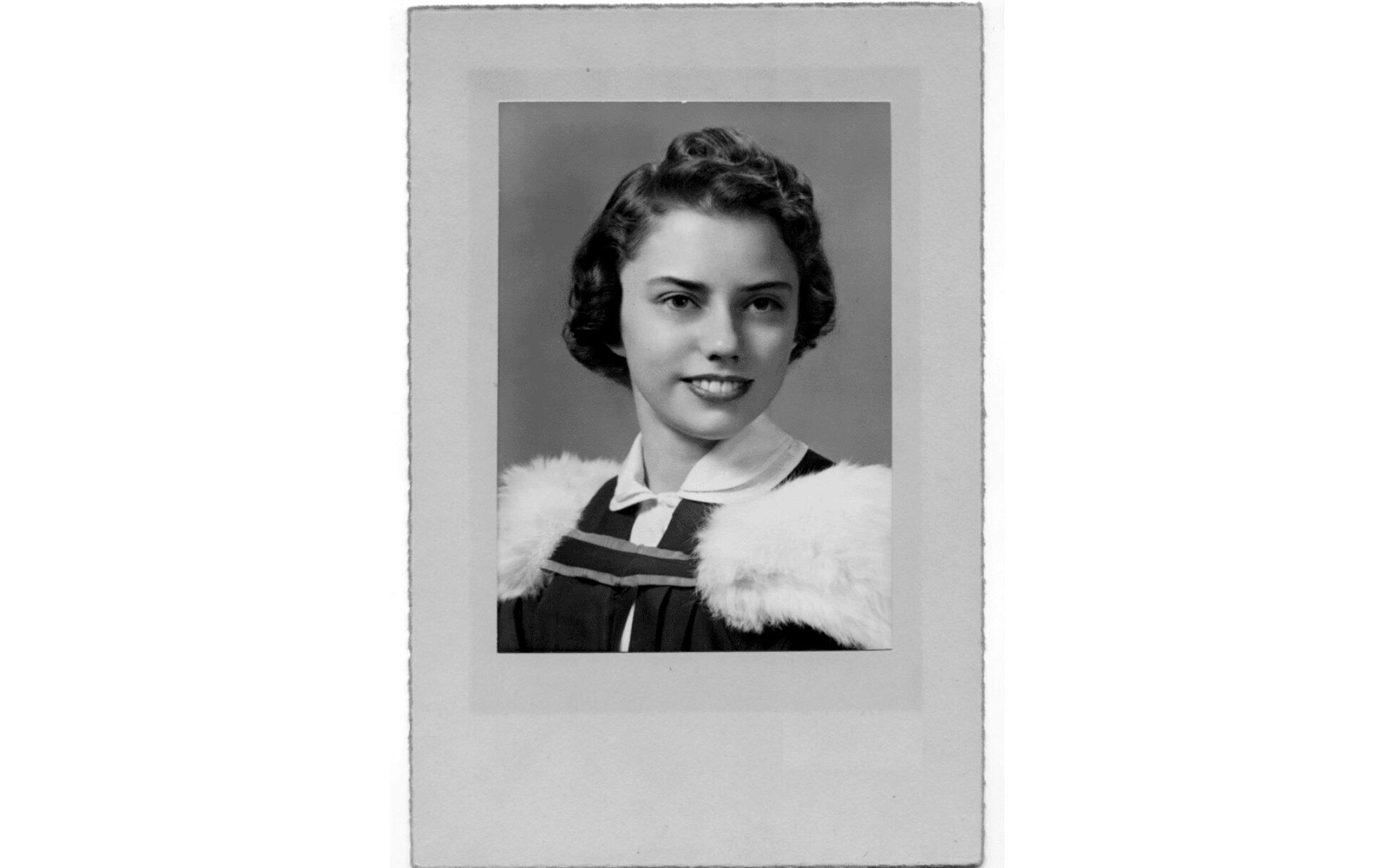
Marjorie Elizabeth Goodfellow, a Bishop's University alumna and lifelong Eastern Townships advocate, has left an estimated $2-million bequest to create a research chair in her name dedicated to the study of Quebec's English-speaking communities, unveiled by the university on June 12. Photo: Courtesy of Bishop’s University
Marjorie Goodfellow's final wish becomes a lasting home for English Quebec studies at Bishop's
Tashi Farmilo
Marjorie Elizabeth Goodfellow spent her life arguing that the story of Quebec's English-speaking communities deserved to be studied, defended, and remembered. Bishop's University showed how far that conviction reached on June 12, two years after her death, when it announced a research chair in her name funded by an estimated $2-million bequest from her estate. The Marjorie Elizabeth Goodfellow Chair in English Quebec Studies was unveiled at the university library in Lennoxville before her family, university leaders, and representatives of Eastern Townships organizations.
Goodfellow was born in 1938 and raised near Sherbrooke. She graduated from Bishop's in 1959, earned a Master of Library Science from McGill in 1967, and worked in Ottawa and Montreal before returning to the Townships in the early 1970s, where she built a career as a library consultant and a researcher devoted to local history and genealogy. She helped found the Townshippers' Association in 1979 and spent decades fighting for the rights of the anglophone minority, with a particular focus on equal access to health care. She served thirteen years on the board of the regional hospital body now known as the CHUS, advised Quebec's health minister through a provincial committee, joined Bishop's board of trustees in 1985, and received an honorary Doctor of Civil Law from the university in 1993. At the time of her death she was still completing her first book, a history of the Brompton Road community where she grew up, told through her mother's diary, and left the manuscript unfinished.
The gift was decades in the making. Goodfellow had written the chair into her will roughly twenty-five years before the announcement and kept it through later revisions, so the plan existed long before anyone knew of it. The university learned of the bequest only after she died in October 2024.
It surfaced at a tense moment for anglophone Quebec. The same week, the Coalition Avenir Québec government dropped its proposed Quebec Constitution Act, Bill 1, which died when the legislative session ended on June 13 after heavy opposition from anglophone, Indigenous, and civil-liberties groups. The government said it had run out of time and would try again. Set against that uncertainty, Goodfellow's gift looks less like a response to the moment than a bet she placed long ago, that the community's history would still need careful keeping.
The chair is built to range widely. Rather than sit in a single department, it will draw on history, literature, sociology, political science, education, and linguistics to study the language, culture, and shifting identity of English-speaking Quebec within the larger provincial and national picture. The chairholder will lead research, shape curriculum, mentor students, and connect the university to the community through conferences, public lectures, and other efforts to carry scholarship into wider conversation.
Vice-Principal Academic and Research Dr. Kerry Hull called the position "an exceptional opportunity for our institution," one that would open a space for dialogue among faculty, students, and community partners, with lessons reaching beyond Quebec to other minority-language settings. Faculty studying English-speaking Quebec could become eligible to apply as early as the fall of 2027, with a first appointment expected in the fall of 2028. The chair is designed to rotate after one or two five-year terms, so that new questions keep reshaping it.
Principal and Vice-Chancellor Sébastien Lebel-Grenier tied the gift to the university's own character, describing Bishop's as an institution that has always sat "at the intersection of Quebec's two linguistic communities." That vantage point, he said, would guide the chair's research and its work to preserve and make sense of minority-language life in the province.
For Scott Stevenson, the executor of her estate, the gift suited the woman who made it, reaching past her own lifetime toward the community she never stopped serving. Her decision, he said, "carries on her life's work for the benefit of all Quebecers today and in the future."