
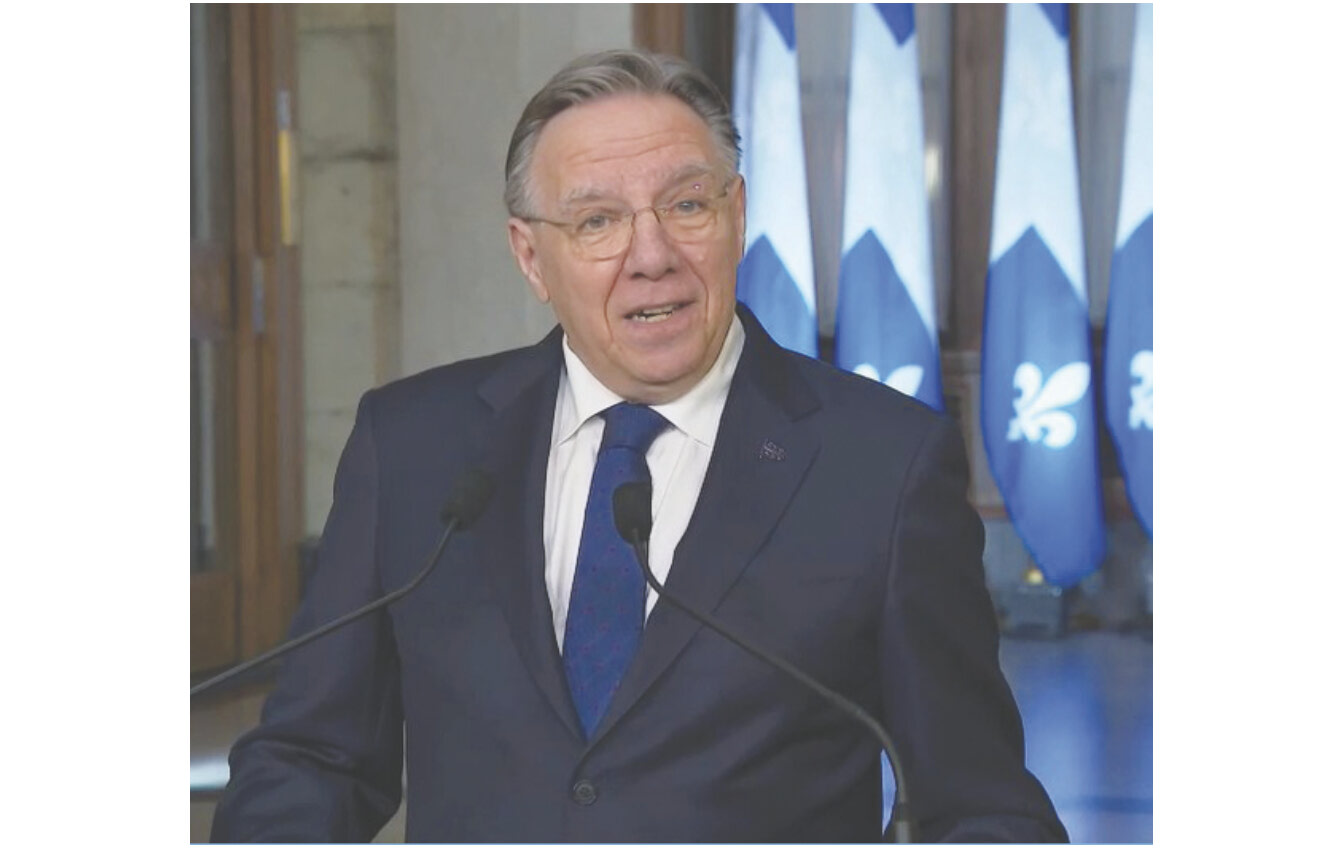
François Legault announced his decision to step down as Quebec premier during a live press conference in Quebec City broadcast on CPAC marking a major leadership transition for the Coalition Avenir Québec weeks after the resignation of former health minister Christian Dubé. Photo: Screenshot of January 14 press conference on CPAC
Legault steps down after Dubé exits weeks earlier
Tashi Farmilo
François Legault announced that he will step down as premier of Quebec, triggering a leadership transition in the Coalition Avenir Québec (CAQ) less than a year before the next provincial election. The statement was delivered during a live press conference on January 14 in Quebec City and broadcast on CPAC.
Legault said he had come to the conclusion that many Quebecers are seeking change, including that of a new premier. He stated his decision was made for the good of the province and his party. He will remain in office for a few months while the CAQ selects a successor.
The resignation comes shortly after Christian Dubé stepped down as health minister on December 18, 2025. Dubé, who served in the role since June 2020, cited the need for new leadership to carry forward the revision of Bill 2, legislation aimed at reforming physician compensation and modernizing governance in the health-care system. He now sits as an independent member of the National Assembly for La Prairie.
In a public letter posted on social media, Dubé acknowledged that while the government reached a tentative agreement with the Fédération des médecins omnipraticiens du Québec to enroll 500,000 new patients by 2026, significant elements of the original legislation had been watered down. He said the government's approach to negotiations, combined with misinformation and resistance from medical federations, contributed to a weakened climate of trust.
Legault, in his announcement and in a follow-up message on social media, outlined his government’s accomplishments over two terms. He cited Quebec’s economic performance, noting that growth in wages and disposable income outpaced other provinces in recent years. He credited a strategy of corporate investment and public infrastructure projects, particularly in energy, with strengthening regional economies and preparing Quebec for long-term challenges.
He pointed to increased public spending, with health, education and culture budgets rising by more than 50 percent over seven years. In health care, his government initiated the construction of new seniors’ homes and revised compensation models for family doctors. In education, it expanded support staffing and introduced a new generation of school infrastructure. He also highlighted the upcoming opening of Quebec’s first National History Museum.
On language and identity, Legault defended legislation adopted by his government, including Bill 21, which restricts religious symbols for public employees in positions of authority, and Bill 96, which reinforces the Charter of the French Language. He raised concerns over the rise in temporary immigration and its impact on the decline of French, especially in urban centres like Montreal and Laval.
Legault also referenced a proposed energy deal with Newfoundland involving Churchill Falls and Gull Island, which was rejected by the newly elected Newfoundland government. He expressed hope that a new agreement would be reached.
In closing, Legault thanked voters, his party colleagues, and his family. He described the founding of the CAQ and its rise to form two majority governments as one of his greatest achievements. He called serving as premier the greatest honour of his life. The CAQ has not yet announced a timeline or process for selecting its next leader.