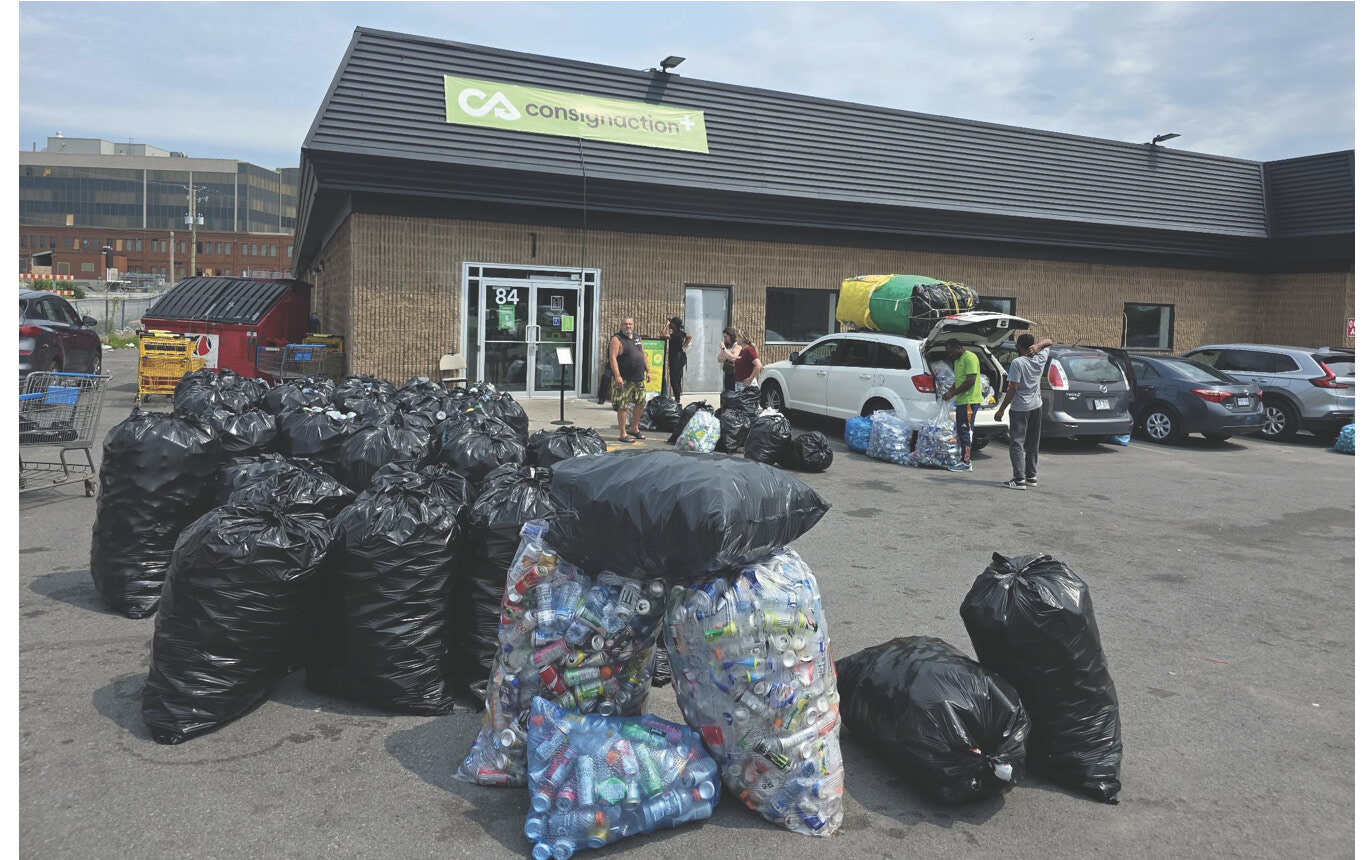
Consignaction is opening at least four new return locations in Gatineau and restricting Ontario residents to Express Return only, after cross-border traffic overwhelmed its Consignaction+ site at 84 Jean-Proulx Street and left local residents facing lineups of up to an hour. Photo: Tashi Farmilo
Consignaction to open new return locations and restrict Ontario returns amid overwhelming demand in Gatineau
Tashi Farmilo
Consignaction announced on August 10 that it will open several new container return locations in Gatineau and restrict Ontario residents to a single return service, after its Consignaction+ site on Jean-Proulx Street drew traffic far beyond its operational capacity.
The move responds to a frustration many Gatineau residents already know first-hand: waits of 30 to 60 minutes or longer at the region's only Consignaction+ site, parking lots filled with Ontario-plated vehicles, and lineups that have at times stretched to almost half a kilometre.
That frustration was on display at 84 Jean-Proulx Street, where residents described a system they feel is being strained by cross-border traffic. Jean Delisle put the grievance plainly: the problem, he said, is that Quebecers pay the deposit on their cans while others do not. "We pay our ten cents; we pay the five cents; and they pay us back," he said, contrasting that with Ontario containers on which no deposit was ever charged. "But there, it's free." He called the volume overwhelming and said Ontario residents should return their cans within their own province.
Not everyone at the site framed it as one-sided. Orville Nitschke, who returns containers on the Ontario side too, pointed out that the flow runs both ways, since Quebecers cross the river to collect refunds on wine bottles in Ontario. "Our lineup at the beer store when returning bottles is longer too," he said. He shrugged off the friction in favour of open movement between the provinces, calling it a matter of give and take.
Both men, from opposite banks, were circling the same fault line, and it is one Quebec is set to redraw. The third and final phase of the province's deposit modernization takes effect March 1, 2027, extending the deposit to glass and multilayer carton containers between 100 millilitres and two litres, including wine and spirits bottles as well as milk and juice cartons. Beer bottles and aluminum cans already carry a deposit. The expansion, originally slated for 2025, was pushed back after repeated delays in opening new return sites, and Consignaction is required to have at least 400 locations in place by that date.
The AQRCB, which operates under the Consignaction brand, said the Jean-Proulx site has seen exceptionally high volumes since it opened, and attributed much of the surge to the region's cross-border reality with Ontario. The distinction it draws is financial: Ontario charges no deposit on non-alcoholic cans and bottles, so those containers carry nothing to reclaim in Quebec. Consignaction reiterated that only containers bought in Quebec, on which a Quebec deposit was actually paid, are eligible for reimbursement, and that claiming a refund on containers purchased elsewhere is illegal. The Quebec food retailers' association has previously described the practice in the Outaouais as resembling fraud, since it loads costs onto a program those deposits never funded.
To spread out demand, Consignaction confirmed it has obtained municipal authorizations for four new return locations, at 75 Plateau Blvd., 140 Gréber Blvd., 178 Main Street, and 1100 Montreal West Road, with three more planned for the area. The rollout is part of the gradual buildout of the return network under the modernized system, which expanded in March 2025 to cover all ready-to-drink plastic beverage containers from 100 millilitres to two litres.
The organization also said it will require Ontario residents seeking to recover a deposit they paid in Quebec to use the Express Return service exclusively, a change taking effect in the coming days, and reserved the right to add mechanisms to verify where containers were purchased. It is a notable shift. In earlier statements, Consignaction said existing regulations left it unable to demand proof of residence and described its hands as tied.
"We are very aware of the inconvenience caused by the exceptionally high volume of customers at the Consignaction+ return location in Gatineau. We have already extended opening hours and added resources on the ground, but we realize we need to go even further," said Jean-François Lefort, vice-president of strategy. "We will therefore rapidly increase the network's capacity in Gatineau, while tightening our measures to ensure that only deposits actually paid for in Quebec are reimbursed and that Gatineau residents receive the service to which they are entitled. Our responsibility is both to provide efficient service to citizens and to protect the integrity of Quebec's deposit system."
For smaller quantities, Consignaction encouraged residents to use participating retailers across Gatineau rather than travelling to the return site and thanked them for their patience.
Whether these measures ease the crush remains an open question. More sites, the Express Return restriction, and possible verification checks target symptoms rather than the underlying asymmetry, the mismatch that draws drivers across the river in the first place. That gap is set to narrow in March 2027, when Quebec's deposit expands to wine and spirits bottles. Until then, Gatineau's return sites absorb pressure that neither the barcode system nor the current rules were built to sort out. As Nitschke put it, from the other side of the same problem: "We're all Canadians."